

Everything Ocean Podcast
Shark series part 2: The 45mm Rule - When Bull Sharks Are Actually a Risk
Shark series part 2: fisheries and shark scientist Dr Daryl McPhee gives Dan the three conditions that put bull sharks on Sydney beaches - 45mm of rain, 1.8-2.8m swell, and afternoon - plus what actually triggers a white shark encounter, why the "sharks are starving" theory is wrong, and an honest ranking of every personal deterrent on the market.
Everything Ocean Podcast — Episode 2, and the first in our shark chat series, featuring Dr Daryl McPhee, marine biologist, fisheries scientist and shark researcher.
This is the episode that kicked off the shark series, and it's the most practically useful hour we've recorded. Dr Daryl McPhee is one of Australia's leading experts in fisheries, shark ecology and coastal management — author of the only book dedicated solely to fisheries management in Australia, a former director of the Fisheries Research and Development Corporation, and more recently focused on unprovoked shark bites, shark behaviour, and which mitigation strategies actually work.
Dan came to this one with skin in the game. He runs the surf school at Dee Why and was on the beach the day Mercury Psillakis was fatally attacked last September — close enough to be running down the sand with a shark trauma kit. As he says in the intro, he doesn't have a stance. He wants the data.
Listen or watch: Spotify · YouTube · search "Everything Ocean Podcast" on Apple Podcasts.
Here's what stood out.
The 45mm rule: three conditions that put bull sharks on your beach
This is the single most useful thing in the episode, and it's the reason we named the episode after it. Bull shark risk isn't vague — Daryl breaks it into three measurable factors.
1. Rainfall — about 45mm in the catchment, over a relatively short period. Not a few coastal showers. It has to be enough to actually flush the river systems and change water quality at the beach. The threshold varies by catchment; a short coastal catchment further north could need less.
2. Swell height — roughly 1.8m to 2.8m. That's the band bull sharks seem to prefer.
3. Time of day — midday onwards. The tracking data has bull sharks using nearshore areas from about midday, through the afternoon and into the early hours of the morning, then heading out to deeper water.
Flip that around and you get an answer Dan can actually give a nervous parent. The safest window for bull sharks in summer: in the morning, after less than 45mm of rain in the catchment, with swell around 1.8m or under.
And the corollary matters just as much. A passing summer shower while the water is still clear is not the trigger. What you're watching for is the murky plume that comes out after serious rainfall — the January event was around 100mm a day for three days, and the water was brown for over a week. If you do get a localised flush, say out of Narrabeen Lagoon, Daryl's practical tip is to work out where the plume is heading (usually north) and surf to the south of it.

White sharks: forget the rain, watch the bait
Completely different animal, completely different trigger. For white sharks, rainfall is a much weaker signal. The factor Daryl pulls out as the biggest concern is the presence of large schools of bait fish.
That's borne out by the timing of the two Sydney bites Dan raises: Mercury Psillakis at Dee Why was a clear sunny day around 11am, and Coogee was a stunning still day, also around 11am. Neither fits the rain story. At Coogee, when the drone went up, there did appear to be schools of bait fish in close.
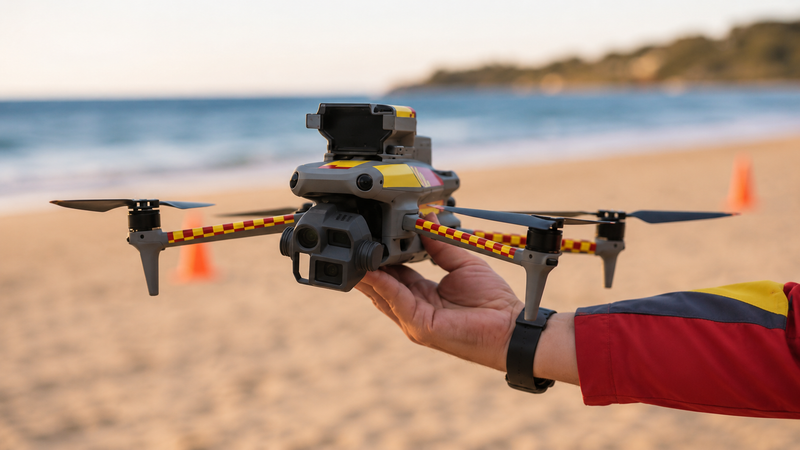
The upside is that this is exactly the kind of thing the new drone network should be good at — spotting bait schools that are sitting in a corner of a beach rather than just moving through from headland to headland.
Is it actually getting worse? The long-term numbers
Daryl's first move is to refuse the year-on-year question. Bite numbers are low and highly variable, so you have to look at blocks of time. Averaged across Australia, fatal bites per year:
- 1980–1999: about 0.8 — less than one a year
- 2000–2019: 1.65
- 2020–2025: 4
So yes — there's a real long-term upward trend, not just a media effect. But two things complicate the picture. First, the worst period on record was the 1920s to 1939, before nets and with a very different beach culture; many of those bites were in rivers and creeks, and with limited first aid and long trips to hospital, the fatality rate from a given bite was far higher.
Second — and this is the finding that undercuts the "there are just more people in the water" explanation — the increase in bites is above per capita. Bites have risen faster than population growth.
The "sharks are starving" myth
You've seen this one in every comment section: we've overfished the ocean, the sharks are hungry, so they're biting people. Daryl's assessment is blunt — it is "absolutely incorrect." It implies a shark sitting in one spot starving to the point where it bites a person, which is not how any of this works.
If anything the evidence runs the other way, and this is the more uncomfortable idea in the episode: coastal food resources have recovered. Whale numbers are up. Seal and sea lion populations are up. And Australian salmon — heavily fished in the 1980s for the cannery at Eden, to the point where the schools barely made it past Sydney — now run all the way to the Sunshine Coast again. Add pilchards to that.
Sharks range until they find food, then stay while the food lasts. More prey, in closer, for longer, is one factor — Daryl stresses one factor — behind the rise in bites. A healthier ocean has a cost attached to it.
Are there more sharks? The honest answer is we don't know
Daryl is upfront that this answer satisfies nobody, but it's the answer. White sharks were protected without a baseline population estimate ever being established. For bull sharks, "it really is a guess." Tiger sharks are the exception — Queensland data suggests a significant long-term decline.
What we can say about bull sharks is more specific and more useful: there's no scientific evidence their population has increased, but there is evidence they're spending more time around Sydney each year. Arriving earlier, staying later, ranging further south. Layer several wet years on top of that and you get more overlap with people without needing more sharks.
His own data point, offered as anecdote rather than science: 35-plus years of fishing, and he's interacting with noticeably more bull sharks over the last five to ten years.
Drones: what they'll fix, and what they won't
On the $120 million NSW program, Daryl thinks it's the best thing the government can do in the short term — with a clear-eyed caveat about where it works.
Drones will genuinely improve things for white sharks in the cooler months, when the nets are out. White sharks sit relatively high in the water column, the water's clear, the swell is often low — they're findable. But in optimal bull shark conditions (heavy rain, murky water, bigger swell, an animal sitting near the bottom) it's a much harder ask.
The flip side he's confident about: a lot more beach closures over the next 12 months. Some surfers have told him they'd rather not know. And the closures need to be for the right animals — earlier this year beaches were being closed for small hammerheads, a small dusky whaler, and at one point a wobbegong that poked its nose around Manly. (Manly is genuinely a wobbegong-bite hotspot, Daryl notes, because people stand on them — painful, but not the same phenomenon at all.)
Long term, the drones should give us good estimates of change in the number of large sharks using beaches, which for bite risk is the number that actually matters.
Nets: why they stay
You can't run a proper experiment on nets — that would mean deliberately putting people at risk. The correlative evidence points to fewer bites, especially when they were first introduced around Sydney in 1937. But Daryl is careful: a range of factors were interacting over that period, including game fishing and commercial fishing pressure, so you can't cleanly attribute it.
The more interesting answer is why they're still in the water, and it has little to do with science:
- No minister wants to be the one who pulled the nets out. Statistically a bite will occur somewhere within a 12-month window regardless of whether the nets were doing anything.
- Status quo bias. When something has been in place a long time, the default decision is to continue with it — in shark policy as in everything else.
Public opinion swings with the news cycle: after a serious bite, people want nets. After a run of whales caught in them, people want them out. Meanwhile there's been decades of tinkering — pingers in Queensland to alert dolphins and whales, adjustments to net position, mesh size and height, and keeping nets taut so large animals bounce off rather than tangling. It's about as good as the technology gets.

Drum lines — and the myth that they attract sharks
Worth understanding the difference. A SMART drum line alerts a contractor as soon as something is on the hook; the animal is relocated offshore, tagged and released — and tagged sharks tend to scatter and stay off the coast for significant periods. A traditional drum line leaves the bait sitting. In Queensland, a non-dangerous species still alive is released; a white, tiger, or bull shark over 2m is euthanised and sampled.
On the claim that any of this draws sharks to the beach: good research out of Réunion says no. As Daryl puts it, it's a bit of a myth that sharks can smell a drop of blood from kilometres away. Smell matters to them, but a drum line is only catching sharks that were already at that beach.
And the distinction people conflate: culling means reducing a population. Nets and drum lines aim to remove sharks locally present — not unrelated to population size, but not the explicit aim. Which is why you get people who support one and not the other, in both directions.
Every personal deterrent, ranked
Electric — the only category with real evidence. Ocean Guardian / Shark Shield (not in commercial production at the moment, though Daryl suspects it'll be revived) and Rpela, which is embedded in the board rather than attached to it. Both overwhelm the shark's ampullae of Lorenzini — the pores it uses to detect prey — which link directly to the jaw movement in the final part of a bite. Both have been independently tested multiple times and shown to statistically reduce the chance of a bite. "It's not just a Batman shark spray," as he puts it. Surfers do report taking time to get used to the shock.
Shark bands — the one to be careful with. The single set of independent testing found no deterrent effect. The supporting material tends to be papers on magnets in offshore tuna longline fisheries, tested on smaller pelagic species — whitetips, lemon sharks — and even there the results are equivocal, with the majority showing no effect. The one study on white sharks showed they weren't effective. Manufacturers do note in the fine print that they aren't 100%. Daryl's real concern is behavioural: someone paddling out into murky post-rain water because they're wearing one.
Shark eyes — unproven, and possibly counterproductive. The biomimicry logic borrows from eye spots on butterflyfish, but those spots are probably about mate and species recognition rather than deterring predators. More importantly, Daryl suspects a shark coming from below can't see the underside of the board at all — it sees a silhouette and signs of life. And if it could see the eyes, he makes the case they might encourage a bite, by giving the shark something to orientate on: inanimate objects don't have eyes. They haven't been independently tested. If they were, and they worked, he says he'd change his thinking.
Shark-proof wetsuits — the sleeper pick. Flinders University tested them properly, measuring shark bite force and then building a hydraulic shark jaw in the lab to apply to wetsuit material. These don't reduce the chance of a bite — they reduce the consequence, potentially turning a life-changing injury into lacerations and heavy bruising. And unlike every other option, you're not buying an extra piece of kit. You're buying a wetsuit you were going to buy anyway.
What he'd build with unlimited money
Multispectral drones. Originally military technology for finding sea mines at depth, long since civilian. They read different wavelengths of light, so they can see into the water column where the naked eye and a standard camera can't — exactly the murky bull shark conditions the current drones struggle with. Pair that with better AI: you'll never get resolution fine enough to call 1.9m versus 2m, but swimming pattern can tell you that's a white shark, about 1.5m, keep watching — versus that's a large dusky whaler, or that's clearly a hammerhead, no alarm needed.
Better electric deterrents, with surfers actually consulted. They're the most effective option and have the least impact on wildlife. What's missing is buy-in on price point and usability. Dan mentions talk of a major fin brand building them into fins — the fins being the heaviest part of the board anyway, so the performance hit would be minimal. Daryl likes the logic.
Barrier technology worth trialling. Not the physical barriers attempted in northern NSW, which were never going to work and which surfers didn't want halfway through a barrel anyway. He means the "shark safe barrier" — permanent magnets plus visual deterrents — and the electric cables trialled in South Africa. Somewhere like Coogee, headland to headland, without impeding the wave, could be a candidate.
"Just put flake back on the menu"
The reality check on the culling argument is mostly about economics, and it's worth knowing before you repeat the line.
We never ate white sharks. We don't eat tiger sharks. We don't eat large bull sharks — there are health advisories about heavy metals in large sharks, plus, in Sydney Harbour's case, dioxins. Daryl has eaten large bull shark in his misspent youth and describes them as "absolutely terrible." Then there's the practical end: you can't fit a 2m bull shark in an esky, so it sits in the sun for hours before anyone deals with the mountain of flesh that comes off it. Sydney Fish Market doesn't want them — no value, and nobody wants to market a product carrying a 150-grams-a-week advisory. As Dan put it: not exactly a glowing culinary endorsement.
Also worth knowing: under Australia's fish naming convention, only gummy shark from Victoria and rig from New Zealand can legally be sold as flake, plus tropical flake, which is largely blacktip whaler. Daryl actually supports commercial shark fishing where it produces good product — he's done work with the aged care sector, where shark is valued as an heirloom food that happens to be boneless. But the economics of a large-shark fishery simply don't stack up, and the fin market has been depressed for about a decade since Chinese government banquets and big weddings dropped shark fin soup.
And the dead-shark-deters-other-sharks theory
Dan raises the drum line version of this, and Daryl's answer is more nuanced than a flat no. There is a chemical deterrent out of the US, developed and trialled in the Bahamas, built on the observation that small reef sharks avoid areas where dead sharks are — a specific mix of decaying shark tissue, a necromone. Commercial longliners reported something similar.
But the testing was on small reef whalers. White, tiger and bull sharks all eat other sharks. So he'd caution strongly against transferring that result to apex predators — where it may well have the opposite effect.
Where he lands
Asked whether Australia has the balance right between protecting sharks and protecting ocean users, he won't give a yes or no — the community view swings with events. What he will say is that NSW's long-term bite trend is at least starting to plateau, while Western Australia's is still climbing, and WA hasn't adapted the way NSW and Queensland have. "I know the WA government doesn't like me saying it."
On why Victoria and Tasmania see so few bites despite having white sharks: no bull or tiger sharks, far less time in the water (especially Tasmania), different beach types, no whale migration, fewer large schools of migratory fish — and sharks that are further offshore. Less spatial overlap, rather than better-fed sharks.
And after a career of studying them, is he less comfortable in the water? No. Just as comfortable. He sees more sharks when he's fishing, and he's more careful about where he fishes and where he disposes of fish frames — no interest in conditioning sharks to an area where kids are paddling.
Catch the rest of the shark series and every episode under the Podcast filter in From the Lineup.
Full episode transcript
Read the full transcript (auto-generated — tap to expand)
This transcript was generated automatically from the episode audio and lightly cleaned up, so expect the odd mis-heard word.
[00:55] Good day everyone, Dan here. I just want to introduce the first episode of an ongoing series which is going to be called our shark chat series. I wanted to give you a bit of background on why this issue has struck personal relevance with me. This mainly comes through lived experience of owning the surf school at Dee Why Beach, and being there last September when Mercury Psillakis was fatally attacked by a great white shark. I was actually just in between my lessons and saw a bit of a commotion. I know the lifeguards really well — saw them going to the jet ski, tried to go over and assist them getting the jet ski in the water. In that time Mercury had been washed in and a few people were helping him up the beach. I ran and got my shark trauma kit from the van and started running it down the beach towards him, before getting close enough to realise there would be no resuscitation attempts.
[02:00] I've seen how these kinds of tragedies really affect communities and surfing communities, especially the community I'm in on the Northern Beaches. It's been quite a journey to see how that confidence ebbs and flows, and the new measures being implemented have helped, but they're a bit of a double-edged sword, because now everyone's a lot more aware of what's out there. So these conversations are about getting as much information from a variety of different experts — from people with lived experience, from scientists — really trying to bring data and lived experience into the one place. I don't particularly have a stance at the moment. I just have an open mind about how to best keep humans safe, first and foremost, and then also keep marine life safe and protect that in whatever capacity we can.
[03:01] Today's guest is Daryl McPhee, one of Australia's leading experts in fisheries, shark ecology and coastal management. Daryl's research brings together ecological, economic and social perspectives on some of the biggest challenges facing our coastlines. He has an extensive background in fisheries research, is the author of the only book dedicated solely to fisheries management in Australia, and previously served as a director of the Fisheries Research and Development Corporation. Most recently Daryl's work has focused on unprovoked shark bites, shark behaviour and the effectiveness of different shark risk mitigation strategies.
[03:34] Good day Daryl, welcome to the podcast. Thanks for making the time to join us today. — Pleasure to be here. — With all the shark incidents occurring across New South Wales at the moment, and in the last six months, there's no better person to talk to about this topic. I want to kick off by saying it appears 2025 was our worst year for fatal shark bites in Australia yet. Are shark interactions and fatalities becoming more prevalent, or is that something that just feels like it's happening through the media and more eyes on the water?
[04:16] There's a media influence, there's more eyes on the water. The key to answering the question is not to look at things year to year, because the number of bites is low — which is good — and they can be highly variable. We need to look long term, over blocks of time. Between 1980 and 1999 there was less than one bite per year on average — about 0.8. Between 2000 and 2019 that had increased to 1.65 on average. It's a shorter time frame but it's still relevant. Between 2020 and 2025 that average had increased to four. And sadly in 2026 we've already had four this year. So there is a long-term trend of increased fatal bites. But the highest number of fatal bites was between the 1920s and 1939 — very different water use and beach culture then, of course, and many of those bites were in rivers and creeks.
[05:21] That is one thing I found fascinating, because that period you mentioned was prior to nets. — Yes, nets and culling. — Did they come in at the same time? I remember I had another marine biologist on, Dr Robert Harcourt, and he was saying there was essentially an attack every year around the Sydney area, around Coogee, and then they put the nets in and there wasn't one from 1937 until 2020. So that's 83 years with only one fatal shark attack in there, potentially. — Yes, from memory. There was a shark control program, which is a form of local lethal means. There was also probably a large number caught by game fishers as game fishing developed, and obviously some interactions with commercial fishing as well.
[06:38] Did the nets and those control methods come in at the same time? — No, fishing evolved over a longer period of time. But the nets came in in 1937 around Sydney, from memory. — So it would be hard to correlate which prevention methods worked, the nets or population control, for reducing shark fatalities and bites. — And just very different patterns of water use as well. If we look at Queensland, where I am, a lot of the fatal bites were in the Brisbane River, where no one swims any more for various reasons, and the Ross River at Townsville. So you had this series of inshore fatal bites. You also had less knowledge of first aid, less ability to apply first aid, and longer distances to hospitals. So the fatality rate from early bites was much higher. Some of my work has looked at the extent of those early injuries — some of those people would not have survived regardless of first aid, but at least some in a modern-day sense would have.
[07:49] I think that's one thing that's really coming a long way now — early access, people straight on the job who know what they're doing, so many first responders who are doctors or nurses, and the shark bite kits have been really helpful. Let's talk about those shark attacks that are happening. What species are causing those in the different areas?
[08:12] Globally, including in Australia, there are three species responsible for most serious bites and most fatal bites: the white shark, the bull shark and the tiger shark. At least at the moment we can probably park tiger sharks for New South Wales — yes, there have been bites and fatal bites from tiger sharks, but what we've seen the last couple of years in the greater Sydney area has been white sharks and bull sharks. Tiger sharks are mostly nocturnal, so that also contributes. Currently the focus in the Sydney area is bull sharks during the warmer months and white sharks during the cooler months.
[08:55] That's pretty interesting, because in Hawaii they have a lot of tiger shark bites and fatalities. Why do you think our tiger sharks are more likely to leave people alone? — For tiger sharks, yes, they are on beaches — the drones are fairly consistently spotting tiger sharks — but it mostly comes down to their nocturnal feeding. Their eyes are a bit similar to a cat's eyes; if you torch a tiger shark's eyes you get that red reflection back. That's an adaptation to low light levels. Tiger sharks can eat anything and everything, but their food preference is for turtles and marine mammals, particularly dugongs further north. Dugongs do occur occasionally in New South Wales, green turtles do occur in a fair bit of the area, as do loggerhead turtles — but certainly in the Sydney area they're not nesting beaches. So tiger sharks will often hang around turtle rookeries in Queensland, the Northern Territory and Western Australia — Raine Island being probably the most famous one — and pick off turtles. They're uniquely adapted to crunch and saw through that turtle shell. So it's basically due to the times of day that they feed and the locations they feed. There are tiger shark bites in New South Wales, fatal ones, so it's not unknown, but none of the recent serious bites can be attributed to tiger sharks.
[10:47] Whites are a bit more migratory, tiger sharks a bit more territorial? — All three species can move around a lot. Tiger sharks do move significant distances up and down the coast. All three shark species have what's best considered a ranging behaviour — highly variable. The classic migratory animal most people think of in the aquatic environment is salmon: every single salmon in the northern hemisphere goes up the same river en masse. None of our shark species — in fact most of our fish species — have that pattern of migration. They have partial migrations, and there's a lot of inter-animal variation in the movements. What they all do is once they find a spot where there might be some food resources, they stay a while before they move on to the next patch.
[11:57] In terms of global warming — we're seeing tropical fish further down, and I've heard bull sharks are coming down earlier and later. Is global warming affecting where we see tiger sharks? — Tiger sharks, yes. In fact all three species to an extent. The data clearly shows bull sharks are arriving in the greater Sydney area — and by that I mean the Newcastle to Wollongong stretch — spending longer there, and there are probably more of them coming down. Their range is likely to extend further south as well. Same for tiger sharks. It's slightly different for white sharks, in that patterns of upwelling driven by climate change can push more nutrients into the coast, particularly in northern New South Wales. In periods in northern New South Wales we've seen lots and lots of bait fish in close, lots of predatory fish and obviously white sharks as well. White sharks are found at local pockets of high-density prey, and they're probably spending longer there.
[13:04] There are a lot of theories going around about why we're seeing more white shark interactions — overfishing making sharks hungrier, recovering whale populations leading to more food, recovering seal populations, and changing ocean conditions, warming waters, upwelling. It sounds like a contradiction: is there not enough fish, or too much? — Happy to unpack that for you. When you see social media comments after a bite, there are always a few things that come up. One is about the ocean being the shark's domain — we'll park that. But the idea that we've caught all the fish, therefore the sharks are starving and they're biting people, is absolutely incorrect. That implies a shark sitting there in the one spot starving to the extent where it bites people.
[14:42] If we look at the food resources — you mentioned two, I'll mention a third. You've got whales, seals, and schooling fish, particularly Australian salmon. Nobody doubts that white sharks in particular eat whales. Nobody doubts that the whale population has increased. I've never quite known why those two facts are ignored by people who think there's no food available. I think it's a cognitively easy thing to throw out there from keyboard warriors. Seals as well in the southern parts of the states — seal and sea lion populations, pinnipeds as they're called, have all increased. I'm less concerned about the increase in populations of those animals for bull sharks, because the ranges don't particularly overlap.
[15:37] And then Australian salmon. The population of Australian salmon on the east coast was very low during the 1980s due to significant fishing pressure from commercial fishing for canning — there used to be a cannery at Eden. They're a migratory fish. Before that heavy fishing pressure they used to migrate right up the coast, as far as the mid north coast to the northern coast of New South Wales. When the canning activities were at their peak they wouldn't get much past Sydney. Now they go up as far as the Sunshine Coast again. So you've got very large schools, lots of drone footage of them, and you also have schools of pilchards. So you've got this significant collection of coastal food resources that have recovered — and no one is doubting that they have recovered — which is suitable food for large sharks. So I'm strongly of the view that increases in abundance of prey items, married with the biology of the animals — you move around till you find food, and when you find food you stay there as long as that food's there and the conditions are right — is one factor, and I stress one factor, that can contribute to this rise in bites.
[17:01] So it sounds like the ocean is becoming healthier, the food resources are starting to restock, and more shark interactions are probably a result of a more healthy ocean? — Yeah, it is. And there's a factor in there as well — obviously more people in the water over a larger geographic area. But some of my early work suggested, and it's been borne out the last few years as well, that the increase in bites is above a per capita bite. So it's not just the case that there's more people in the water. It's more than that. Our population has increased, but not all of that population increase has the same pattern of beach usage. The number of bites has increased above population growth. — And that's the important point.
[18:14] It does feel like, especially in Sydney at the moment, that ocean use is on the decline. I normally go out at Dee Why Beach every morning for surf lessons, and when I first started the surf school there two years ago there'd be 30 people out pretty much no matter the conditions — kids, the regulars you'd see there surfing every day because that was their habit. That's definitely changed a lot now. Essentially every morning it's mainly just me, whoever I coach, one or two other people, and about five stand-up paddle boarders — which I find pretty interesting, that the SUPs are still out there braving it, because they're above the water, so they're in a bit of a different playing field. For those surfers listening, what environmental conditions would you be looking out for as a time of increased risk?
[19:23] I need to unpack the two species, bull sharks and white sharks, because they're very different. Bull sharks have that strong link to flooding conditions and rainfall, but it's a little more complicated than the fact that it rains somewhere so there's going to be heightened bull shark activity. You need that significant flush in the river systems. The data available suggests you need about 45 millimetres of rain in the catchment over a relatively short period of time. So not just a few coastal showers — it needs to actually have an impact on the water quality and water conditions at the beach. And sadly, what we had in January when that young boy lost his life was quite an unseasonal flushing, more like a tropical storm.
[20:17] I think it was like 100 mil of rain for three days in a row. I went up the coast for it because there was no way we could work with that. But that's an interesting point, because since that happened I often get parents messaging me any time it rains in summer — "oh, it's raining, we don't want to do a surf lesson because of the increased bull shark activity" — and the water's still quite clear. I think that's a distinction people need to know. — I think that's the clear distinction. So 45 millimetres — there are three factors that influence whether bull sharks are using beaches. That rainfall: when you get more than 45mm in a catchment, and it will vary between catchments given the flush — if you've got a short coastal catchment further north it could be less. Then you've got swell height. There's a link between swell height — anything over about 1.8m and up to 2.8m the bull sharks seem to prefer. And we're talking summer now. And it's also the time of day.
[21:29] Bull sharks, based on all that tracking data, seem to use nearshore areas from about midday onwards, or through the afternoon, right through to the earlier hours of the morning. And then they head out to deep water for probably a bit of a rest. So turning those factors around — what's the safest time? In your line of work, if a parent asked, can you give me the answer? — For bull sharks in summer, it will be in the morning, when you've had less than 45mm of rain in the catchment, and when swell is about 1.8m or less. So you've got a set of factors to work with.
[22:15] That seems quite consistent with the Sydney attacks from that period. I think they were all heaps of rain, big swell, and in the afternoon, most of them. — So you've got a set of factors at least, and it will vary in other places. I'm not saying those factors are relevant for Western Australia, for example, but you do have a set of factors surfers can work with. White sharks is a little more complicated. Obviously winter water temperature, but they can persist in quite a range of water temperatures — they are, up to a point, warm-blooded, so they can adjust their internal heat. The biggest factor there to avoid is the presence of bait fish, large schools. Unfortunately what happened at Coogee — and it's not the fault of the victim or anybody present or the surf life saving club there — but when that drone went up there did seem to be some schools of bait fish there. They're probably going to be there most places, but certainly further north, on the New South Wales north coast, when you get really big schools of bait fish, that's your heightened risk. There is some link between rainfall as well, but from memory I don't think it's as strong.
[23:41] This is a question I get quite a lot: does rainfall affect white sharks? Because the one with Mercury Psillakis, when I was there last September, that was a clear sunny day about 11am. And then the most recent one at Coogee as well — stunning day, completely still, about 11am. — There's no one factor, but if I was to pull out the one of greatest concern, it's often the presence of those bait fish in close. And with the new drone approach that should be able to pick up those schools of bait fish as well, when they're sticking in a corner of a beach rather than just passing through from headland to headland. So there's no one factor, but it's important to unpack the two species — and at least for bull sharks, to give a level of comfort to listeners, the fact that we do know enough to provide relatively good information on when the risk is higher and when the risk is lower, and that's without any real-time drone information as well.
[25:00] That 45mm of rain is pretty important, because now any time it's even showering I've got people saying it's summer, it's raining, we can't — and the water quality is still completely clear. It's when it really affects the quality of the water where you can't see through it. — That's right. You can get those coastal showers, you look at the surf conditions and you can't see any difference. It's that flush of murky water that comes out after serious rainfall. — And that was last summer, a proper serious rainfall. Three days of 100 mils. The water was brown for over a week. — And even if you have localised rainfall — you might get a bit of a flush from Narrabeen Lagoon if it's open — probably the solution there for surfing is to work out where that plume goes, which will be north, and have a look to the south of it, away from it. — You can make some small tweaks as well.
[26:08] People do seem a bit divided on the shark population theories. You get people online saying they're disappearing, the numbers are decreasing, and then there's anecdotal evidence that especially the big three species are rebounding, because we're seeing more of them. Where does the science sit on this today?
[26:45] It's a question I get a lot, and the answer doesn't really satisfy anybody, but the answer is the answer. For white sharks, when they were protected by the Howard government, there was no baseline estimate of their population number. We did know that back in the day mortality was fairly low anyway, in that they weren't a commercial species, so they were never in fish and chips. Game fishing had long since stopped catching them and hanging them up. We still had mortality, and have mortality, in shark control programs. So we didn't have a good baseline handle on that population when they were protected. Likewise for bull sharks, it really is a guess. We have no handle on what those bull shark numbers are. And tiger sharks — there's strong suggestion based on the Queensland data of a very significant long-term decline.
[27:49] Do you think with the new drone program this is going to be our best data capture of working out how many sharks there might actually be? — It'll add some information. What it will do is give good long-term estimates of changes in large sharks that are using beaches, which in effect for shark bites is our key issue. It may add to our overall information on population changes, but it's one aspect only. The issue with drones will be — and it's an obvious one, and we've seen it at Bondi recently — the more drones that are in the air for longer periods, the more sharks that will be spotted, and the more beach closures there will be. Some people, including surfers, have told me they're actually happier not knowing that sharks are there. They're not surfing now because they don't want to go to the beach and get pulled out of the water.
[29:21] Some of those beaches were closed for harmless sharks — some small hammerheads, a small dusky whaler. I think there was even a wobbegong closure, when that wobbegong around Manly headland poked its nose out and had a bit of a paddle around the beach. So when a beach is closed it needs to be for a large shark, and of a species that can bite people.
[29:44] I was talking to one of the drone pilots at Dee Why yesterday, because they spotted about a one-and-a-half metre dusky. He was saying the protocol at the moment is that a shark over 2m is considered dangerous. So he spotted that one and didn't close the beach — I think he reported it to the lifeguards and they just kept an eye on it. Which is good, because we don't want the beaches closed all the time from seeing all kinds of sharks. — And Manly Beach is an actual hotspot for wobbegong bites, because people have stood on them over the years. It's obviously a painful nip, but that's not the same phenomenon as being bitten by a white shark. It's not a life-changing event.
[30:44] Some stats I've seen are that there are 4,000 great whites estimated out there with 500 breeding adults. I didn't get any bull shark numbers, but the rhetoric seems to be that there are a lot more bull sharks and they're breeding a lot quicker. From a surfing standpoint, even five years ago I would surf in the rain in summer and never really give bull sharks a thought. After this summer I'll definitely be super cautious when it's raining in summer and there's big swell. Given that anecdotal evidence, do you think the bull shark population has increased really quickly, as opposed to the white population, which is steadily increasing since it's been protected?
[31:42] We don't have a handle on it. Whilst I'm not a surfer, I am a fisherman — I've got 35 years plus fishing around the place, and I certainly do interact more with bull sharks and a few other shark species. My own personal fishing experience is that I catch and interact with more bull sharks the last five to ten years, the last five in particular, including on the Gold Coast, including at surf spots where I fish at night. And I've heard from a number of other surfers as well, from the New South Wales north coast right down to Sydney, that white shark interactions and sightings seem to be about the same, whereas the fear of bull sharks and the presence of bull sharks seems to have escalated. But there is no scientific information to suggest that their population has increased. There is information to suggest that they are spending more time around the Sydney area each year.
[32:51] So even if they weren't to have increased, just their changing migratory patterns are putting them in an area where there are more people. So there's going to be more interactions regardless. — And coupled with that rainfall — we have had quite a few wet years up and down the coast. So you've got those flushes over time as well. — Well, the last person I had on the podcast was a meteorologist, and he was saying four out of the last five years have been La Niñas, so wet. And this is going to be our first El Niño in a while. So having a dry summer might be good for these shark incidences, as opposed to the really wet years.
[33:46] Talking about the population balance — white sharks don't really have any natural predators besides orcas. What's keeping their population in check? Does the ecosystem regulate their numbers without human intervention, or is it just going to spiral? — Both species have relatively low fecundity — litter size. For bulls there's variation but it's generally about six to eight. Whites is about two to ten. So the ability to increase rapidly is very different to our common fish species, which produce millions of eggs. Bull sharks — the mother, if given a chance, will eat the newly released young. That's why the young bull sharks go flying up the river as quickly as possible, to as shallow water as possible, so mum can't turn around and eat them. Small bull sharks are preyed upon by larger bull sharks. Whether that has an impact at the population level is unknown, but it is a mechanism. White sharks, we simply don't know enough. I suspect predation in Australia is quite low, but the intrinsic ability of those populations to increase in the short term is low, just because they don't produce many offspring.
[35:24] I've heard a myth — South Africa had quite a bad white shark interaction issue, they were having a lot of attacks at one stage, and then apparently the orca population rebounded and at the same time the white shark incidents started to drop off. — I've heard conflicting information. In fact there was some new information out this week that I haven't looked at yet, so I won't give you an answer on it. But your suggestion that the issue is contentious and there's a diversity of views is correct, and it's something I'll try to unpack over the next couple of weeks. Yes, orcas in South Africa prey on white sharks, but whether it's had an impact on that population, or whether it was fishing or something else, is another question.
[36:28] Let's talk mitigation strategies. New South Wales just launched a $120 million drone program — every beach from Palm Beach to Cronulla now has a drone, and every coastal town is going to have at least one beach under drone surveillance. Let's start with shark nets. Do you think they work? — Always a controversial topic. From a scientific perspective you can't do what we call the manipulative experiments to determine whether they work or not, because you'd be deliberately putting people at risk. The correlative information suggests there have been fewer bites over time, particularly when those nets were first introduced. — That was the bit of information we had earlier, wasn't it — basically every year there was a shark attack in the Coogee area, and then they put the nets in and that stopped for 80 years. — Yes, but again there's always a range of factors interacting to influence that low number of bites.
[37:56] Conservationists will often say they don't understand why the government persists with shark nets. The answer to that is twofold. One is that no minister ever wants to be the minister that pulls out the nets and a bite occurs — and the statistics suggest that within a 12-month period a bite will occur somewhere, regardless of whether the nets were doing anything or not. And the second is simply to do with public policy and how we perceive and implement it, not just in sharks but in general, including in business: the status quo bias. When something has been in place for a long time, a government or decision maker will always suggest, okay, well, we had it, we'll just continue with it.
[38:58] It's funny though, because they come out as well — they're not in the full year. — No, they come out for the whales, because they catch whales. And I can track public opinion on the nets. When there's been a serious bite or a fatality, public opinion swings to "we want nets." And then when a series of whales are caught, "we want the nets out." There are obviously people at either end of the spectrum who don't change their views, but there are people in the middle responding to a current news story.
[39:39] Is there a way to make nets more efficient so they deter sharks but have less bycatch? — There's been a lot of effort over the years to tweak those nets. For example, in Queensland pingers are used, which are an acoustic alarm to alert dolphins and whales to the fact that there is something here. It doesn't scare them away so much, it's just a reminder if they're dozing off swimming that there's something ahead they need to be aware of. Not 100% effective — none of this stuff is — but various things have been tried: the position of nets, the mesh size, how tall a net is. If you've got a taut net you've got more chance of a larger animal, particularly a whale, bouncing off, than if you've got lots of slack bits where they can become entangled and drag the net off. So it's something the government has tried and tweaked and will continue to tweak, but it's about as good as we can get at the moment.
[40:50] And then drum lines — smart drum lines and traditional drum lines. There's a lot of mixed feedback, because the shark drum line here is only about 400 or 500 metres off the beach. When it's a really big swell at Manly you pretty much use that shark buoy as your marker — it's about 50m away. So they're close enough to the population that some people are concerned they're bringing sharks closer to shore.
[41:38] I can answer those questions. New South Wales' lethal component has focused on nets. Queensland has had nets and traditional drum lines. Smart drum lines have been implemented throughout much of New South Wales, and smart drum lines are also now used in parts of Queensland. The smart drum line aims to catch large sharks adjacent to beaches, and alert a contractor that something is on the hook. The contractor then goes out, relocates it, the animal is tagged offshore and then released — and they tend to scatter and stay away from the coast for significant periods of time. A traditional drum line, in effect, the line may stay baited for a significant period of time and the animal is caught. In Queensland at least, if the animal is not a dangerous species and it's still alive, it's released. If it's a dangerous species — white shark, tiger shark, or a bull shark over 2m — it is then euthanised and samples are used for various bits of biological assessment.
[42:50] A lot in the media say that smart drum lines and traditional drum lines are just attracting sharks to the beach because there's a bait there. There's been some good research done at Réunion on that particular question, because that was a concern — I think those drum lines were also set very close to where people were surfing. And the answer is actually no, they don't. It's a bit of a myth that sharks can smell drops of blood from kilometres away, or something dead from kilometres away. Their sense of smell is important to them, but a smart drum line or a traditional drum line will only be catching sharks that were already present at that beach anyway.
[44:07] Culling implies, by definition, a reduction in population size, whereas nets and traditional drum lines are trying to remove sharks that are present at a local area. That obviously is not independent of reducing a population size, but it's not an explicit aim of the program. So the two are different, but obviously confounded in a lot of people's minds. Some people support nets and drum lines at beaches but don't support culling, and vice versa.
[44:51] Drones — how effective do you think they're going to be? Is it the best use of our money? — It's a lot of money, and I've seen comments that it's too much, not only for shark mitigation but in terms of public spend overall. And there's a few that say it's not enough. I think it will certainly improve beaches for white sharks during the cooler months, when nets aren't there, because white sharks are relatively easy to see via a drone — they tend to be fairly high up in the water, the water is clear, swell can be low. I think when we have those optimal bull shark conditions of lots of rain, murky water, more swell, for an animal that is generally sitting close to the bottom, it will be more challenging. Yes, it can be managed. But overall it is the best thing that the government can do in the short term.
[46:02] The flip side is more and more beach closures, certainly over the next 12 months. That's going to have an impact on the enjoyment for some people, and maybe their beach participation — but bites have a larger impact. And the patchier distribution of drones was causing concern, because I certainly got feedback after the Coogee bite from people who said they were there that day and they wouldn't have been there if they'd known there were no drones operating. They would have gone to another beach, to Clovelly or somewhere else.
[46:48] Moving on to things you can do personally — there are shark bands, there's Rpela, formerly Ocean Guardian, Shark Eyes, which I've got on all my boards, and there are some shark-proof wetsuits being developed. What are your thoughts on personal deterrents?
[47:18] I'll talk through them. The first types are electric deterrents. There are two: there's the Ocean Guardian Shark Shield, which is not in commercial production at the moment, but I suspect it will be revitalised over time. And then there's the Rpela. For surfers, the Shark Shield was something that could be attached to the board. The Rpela is embedded in the board. So how they're practically applied is different, but they're both based on an electric current which can overwhelm the shark's sensors — their ampullae of Lorenzini, which are little pores they use to detect prey. Why that's important is that the ampullae of Lorenzini directly link to the shark's jaw movements at the last part of a bite. So it can alter that final part of that bite occurring. Surfers have always reported that it takes a little bit of time getting used to the shocks, particularly through the old Shark Shield, because it can produce an electric shock for the wearer. Both have been tested and found to statistically reduce the chance of a bite occurring. So both do work. It's not just a Batman shark spray — they do actually work and have been independently tested a number of times.
[48:50] Then there are the very popular shark bands, which the one set of independent testing suggested didn't have a deterrent effect. There's lots of information on the website which suggests that it does, but it's a collection of scientific paper titles that have tested the use of magnets, mostly in offshore tuna fisheries — high seas tuna fisheries, longline fisheries who don't want to catch sharks, because every shark they catch is one tuna they don't catch. The results are very clearly equivocal. Some papers have suggested they have had a deterrent effect. The majority don't.
[49:37] What sharks were they testing there? — It's been a range over the years. It tends to be the smaller ones, pelagic sharks — whitetips, lemon sharks. There's been a whole range over the years. So that collection of sharks that surfers and swimmers don't really interact with. — Not the ones we're worried about. — And look, the manufacturers do correctly identify in small print that they're not 100% effective. My concern is that the one study which has tested them on white sharks showed they were not effective. My concern is people using them and going into areas where the conditions are likely — after rainfall, murky water — but they go in there thinking, it's okay, I've got a device on, and then they've been bitten. And it's risky for the manufacturers, because people do take legal action at times when a bite occurs. If you're wearing a device and you can demonstrate that you went into the water because you thought you were safe, and then later found out the scientific information suggests otherwise, it's an area of liability for manufacturers.
[51:18] The Shark Eyes — what are your thoughts on those? — Shark Eyes are simple, and that's obviously their advantage. I remember talking to one of the pro surfers around Réunion — he drew broccoli all over the bottom of his board, because he believed that sharks don't eat broccoli, which is probably correct. But he also knew it wasn't real — he was just making the point that these are the things it's come to for us.
[51:58] Shark Eyes are based on the idea of biomimicry. It's something I've unpacked the science for in a new book. Most fish that have that eye spot are small colourful fish, in particular a group of fish called chaetodons, or butterflyfishes — any divers who've dived the reef will be familiar with that group. Those eye spots though are probably largely for mate recognition and intraspecific recognition, rather than predation. It's based on sharks using sight as a key reason they bite. If you look at what a shark sees from below — say we're talking surfing now — they'll see the silhouette of a board, and maybe some splashing, some legs or arms extending from that board, moving. So there'll be significant stimulus from the fact that there's something above that's moving and showing signs of life. I suspect they actually can't see anything that's on the underside of that board. I also make the case that those eye spots, if they did see them, could actually encourage a bite occurring, because it's going to allow the shark to orientate — inanimate objects tend to not have eyes on them. And again, they haven't actually been tested. If they were independently tested and shown to work, I'd change my thinking.
[53:35] I've bought all the stickers for the surf school and about 80% of them are gone, so we just started drawing eyes on them. Interesting to know your thoughts — I might have to rub them off. Shark-proof wetsuits? — Obviously no one's jumped in a wetsuit and had their legs shoved into a shark, but Flinders University tested them and showed they work. They got an understanding of the bite force of the sharks and then basically developed a hydraulic shark jaw in the lab and applied that to wetsuit material. It's different in that it obviously doesn't reduce the risk of a shark bite occurring, but reduces its consequence. So I'm pretty convinced from the available information that they're effective. What's different from Shark Shields and other things is that if you're a surfer that uses a wetsuit, you're not actually buying another piece of kit — you're buying something you might have used anyway, just a different type of wetsuit. What they can do is reduce a fatal bite or a serious bite to lacerations and very serious bruising — change it from a life-changing bite to a bite that might require some recuperation, but where you'll likely still be able to live an active life afterwards. Limbs intact, hopefully.
[55:20] If you were going to build a mitigation strategy from scratch with unlimited funding and resources, what would you be looking at? — It would be looking at drones, but not only the visual drones we use, which are now commercially available — also what are called multispectral drones, which are commercially available, perhaps not at the scale and fit for purpose yet. Their advantage is that they can see through the water column and find things the visual eye under muddy water conditions can't see. Their initial technology was military technology to find sea mines at depth. They've long since been civilian technology, so they can see different wavelengths of light. You up the AI capability on it and make that practical. You'll probably never have resolution to work out whether a shark is 1.9m or 2m, but you can use a swimming pattern to identify — okay, well that's a white shark, and looks about 1.5m, so we'll keep monitoring it, but we might not sound the alarm yet. Versus that's a large dusky whaler, or that's clearly a hammerhead.
[56:38] I'd also look at improving those personal deterrents — particularly the electric ones, which are the most effective but also have the least amount of impact on wildlife. Really getting some buy-in from surfers as to what the price point is for them, and what needs to be done to make them more user friendly. I know there's been some work done, certainly for the Shark Shield, from pro surfers getting input on usability and impacts on surf performance.
[57:24] There's some talk at the moment about FCS or one of the big brands putting them in your fins, which I think could be really good if they just clipped in on fins. That's the heaviest part of the board anyway, so it doesn't impact performance too much. That would be a pretty big one. — Yeah, I know that's happening. I don't have any update on where those guys are at with it, but I can see that's logical as well.
[58:03] A couple of other things. There is a shark safe barrier. We had the physical barriers that were installed, or tried to be installed, in northern New South Wales, which were never going to work. Even if they were going to work, surfers didn't actually want a physical barrier halfway in a barrel — it was going to cause more problems than it was worth. There is what's called a shark safe barrier, which has permanent magnets plus some visual deterrents. And there are also electric cables in South Africa which have been trialled. So with an unlimited budget and freedom to choose, I'd have a look at those under New South Wales and Australian conditions. They may not be suitable, but they're certainly worth trying, because they do deter sharks, or can deter sharks under some conditions, and we know why — it's about making them more effective. Somewhere like Coogee could be a good area for them, because you'd extend something from headland to headland, but have it so it's not impeding wave propagation, wave shape.
[59:20] One of the big ones, which is the heavy debate at the moment, is culling. I find it interesting that the public is so divided on this — we already manage populations of crocodiles, dingoes, snakes, kangaroos. But when people start talking about shark population control it becomes a very heated debate, and a little ironically I think sometimes, because a lot of these people probably eat fish every day.
[1:00:09] The animals you said all have slightly different scenarios. Dingoes do bite and cause fatality sadly, particularly for little kids and toddlers, but when you look at that spatial area it really is limited to K'gari. So you've got a spatial limitation. Snakes envenomate. People sadly do die from snake bite, and it is something landholders, particularly on properties, have to actively manage. But how the public view somebody being eaten by an animal, as opposed to somebody being envenomated, is very different. A snake's not going to slide across a lawn, bite somebody, envenomate them and then slide off — generally the person has actually got to go near that snake, and they don't know the snake's there. Kangaroos, we cull, and I eat kangaroo because it's a great source of lean red meat and iron. We cull them partly on animal welfare grounds, because their numbers boom and bust because of availability of water in the landscape. So the best thing you can do, rather than have them starve to death, is try and manage their numbers within that population's carrying capacity. Crocs — the issue with crocs is that in most cases they don't impact people surfing or swimming in places. So it's a very different type of interaction.
[1:02:02] So sharks are different. Sharks can be at beaches. That's where bites occur. And part of it is also — and it's interesting — the people who are bitten by sharks often have strong links to the community, and I think Mercury was clearly one of those, from what I read, and you're obviously local where he surfed. They're often young people. So they're sort of the epitome of Australian culture — young people out doing something they love at the beach. That adds to that concern. And culling is something that people think is simple, easy, and potentially makes them feel better. It's a tangible response.
[1:03:03] The practical challenges — like I said, we never ate white sharks. We don't eat tiger sharks. We don't eat large bull sharks, in part because there are health advisories about eating large sharks due to natural concentrations of heavy metals, and bull sharks no doubt dioxins from Sydney Harbour. I know there are lots of calls that we'll develop a shark fishery and we'll eat the bull sharks, but truth be known, in my misspent youth when I caught large bull sharks and ate them — they're absolutely terrible to eat. And obviously keeping a large shark: if you've got a 2m bull shark you can't just jam it in your esky and drive back to the boat ramp. So it spends several hours at least sitting in the sun, then you're trying to jam it somewhere to deal with it, and then to deal with the mountain of flesh that comes off it. Sydney Fish Market don't want to deal with large sharks because there's no value in it for them. And there are concerns about marketing large shark due to those health advisories of only eating 150 grams of it per week. — It's not exactly a glowing culinary endorsement.
[1:04:19] So when people say "just put flake back on the menu" — it wasn't any of the three dangerous sharks. What sharks were they? — There is what's called a fish naming convention in Australia. The only species that can legally be called flake are the gummy shark from Victoria, and also rig from New Zealand, which is also a gummy shark. We also sell tropical flake, which is largely blacktip whalers. So I support commercial shark fishing, including tropical shark fishing in Queensland, because you can produce good quality product. I've done a little bit of work with the aged care sector, because it was identified that aged care residents often want to eat what we call heirloom food — things they grew up eating. A couple of those being Australian salmon, sea mullet, and also shark. Shark ticks the box of being boneless, so there's no risk of somebody who might be compromised in terms of what food they can process choking on a bone. But the economics again don't stack up. There is a market for shark — one of my friends sells shark and chips for $10, which is pretty good in this day and age, and does a roaring trade.
[1:05:53] The issue is that we're not going to have a large market. Even if the government said, okay, we're going to remove protection laws, we're going to move any quotas, everyone go catch sharks and sell them — it's just going to be a waste. In terms of the shark as an actual resource, it would be a waste. And then the other argument is, well, we can sell their fins, but the Chinese market for fins has been depressed now for about a decade. Chinese government banquets used to have it on the menu as a status symbol, and they've changed their views. And shark fin soup at weddings — big weddings — is no longer on the menu as well, because of a campaign against the use of shark fins by a really famous Chinese basketball player.
[1:07:09] On the culling thing, something I see a lot is people saying that the cull in Réunion worked. I don't actually know if it worked or not — that's just what you hear. — I did look at that. They initially stopped shark fishing around there because of what's called ciguatera, or tropical food poisoning. It's a strange type of poisoning where you have symptoms for life, so it's quite serious. We manage it in Queensland as well, so you don't keep large fish of certain species. So they removed all shark fishing due to food safety concerns. Then a series of bites occurred. You also had some agricultural flushing as well, was my understanding — so an influx of nutrients into nutrient-poor waters, being in the middle of the Indian Ocean. And then you also had the response of, in effect, a prohibition on surfing and swimming, on going into the water — which of course, when you're a tiny little island in the middle of nowhere that depends on coastal tourism, is not a good outcome. And then they implemented smart drum lines. They implemented a range of things. They tried a whole lot of things, so you can't tease out one thing. You can't say yeah, it worked at Réunion. It may have been a contributing factor given their circumstance of having no mortality of sharks for a while, but the habitat itself is different as well — you've got a tiny little speck which has this significant influx and outflow of animals.
[1:09:03] Was it mainly bull sharks there that were biting people? — Bulls. They had some tiger bites. I think they may have had a couple of white shark bites as well. But I think bull sharks were one of the main species.
[1:09:23] On the Queensland drum lines that are the deadly ones — I've heard, and I don't know if this is a myth, that when sharks bite those drum lines and get left to die on them, that deters other sharks through scent. And I've heard that comes back to sharks essentially thinking there are killer whales in the area, because killer whales will eat a shark's liver and leave the rest of the carcass, and that spreads scent which deters other sharks. Is that plausible?
[1:10:25] I'll unpack that one for you. There is a chemical shark deterrent based out of the US called Repel Sharks, which is actually in a can. It was designed for and trialled in the Bahamas, and was tried mostly on grey reef sharks. It was observed that small reef sharks did avoid areas where dead sharks were, and commercial longliners also reported that sometimes when they had sharks on the line it seemed to deter other sharks coming. So there is some scientific background to it — it's not just ridiculous. But the issue is that for a significant period of time there was no deterrent effect, because there's a specific mix of decaying shark — what's called a necromone — which seems to cause that effect. However, the sharks that were tested, as I said, were small reef whalers. White sharks, tiger sharks and bull sharks all eat other sharks. So you've got two things pulling in either direction. There has been a deterrent effect from decaying shark flesh detected for smaller sharks that are not apex predators or not close to it — but I'd caution transferring those results to larger sharks. — Bigger sharks, it might actually have the opposite effect. Bummer.
[1:11:54] Two last questions. At the moment, do you think Australia has the right balance between protecting sharks and protecting ocean users? — That's a really good question. It's not a yes or no answer. Currently, with what's happened, I think the prevailing community issue will be no, it's swung too heavily towards sharks. But when there are no bites, it swings back the other way. So you've got this dynamic viewpoint. I'm concerned in Western Australia, because those long-term trends in bites — and not just fatal bites, but bites — are still trending up, and they haven't really done as much compared to New South Wales and Queensland in trying to adapt what they've done. They had a series of bites around the Perth area, they did lots of stuff, and they sort of think, okay, well, it's fixed now. At least in New South Wales the trend in bites overall is at least starting to plateau. So there seems to be some stopping of the increase, whereas Western Australia — and I know the WA government doesn't like me saying it — the numbers suggest bites in WA are continuing to increase. So we need to review what they've done.
[1:13:36] As a side note, why is it that Western Australia, South Australia and Sydney at the moment tend to seem like hot spots, and then you've got places like Victoria and Tasmania where they still get white sharks and a similar level of sharks moving through the area, but aren't getting as many bites? Is it food stocks, the current, the typical migratory pattern going a bit wider around those states?
[1:14:13] There's no one answer. A couple of things to think about: neither of those states have bull sharks or tiger sharks, which I know is also the case in South Australia. There's not a whole lot of ocean swimming and ocean surfing in Tasmania. Victoria — white sharks do use those beaches, but when I've driven the Great Ocean Road, I'm just thinking they're very different surf beaches to what we have on the east coast. And you'll know as a surfer, particularly from Victoria, it's a very different wave pattern. Not necessarily large schools of migratory fish in those waters, so I'm not sure those are the beaches where white sharks prefer to hang out. No whale migration either. There are white sharks there, and obviously seals and sea lions. So I just think it's a different habitat.
[1:15:17] My friends all down there have the opinion that the sharks are well fed and further offshore, so they're just happy to leave everyone alone. — I don't necessarily think it's a difference in how well fed they are, but I think it is a case of being further offshore, so you've got less spatial overlap. Like you said, bites have occurred — there are bites in the records — but it's not the issue that it is in four states.
[1:15:45] Final question: after a career of studying sharks, are you personally more or less comfortable in the ocean today than when you first started? — Still just as comfortable. I just see more sharks around the place when I'm fishing. And I'm probably also more cautious — simple stuff, more cautious in terms of where I fish, because I do a lot of beach fishing. Obviously you don't fish between the flags, but I always make sure I'm not even going to be near where there are lots of people. I want to respect other water users as well. And I'm more careful about where I put fish offal as well — make sure I don't dispose of it where there are any kids around, even in an estuary where a kid might be paddling. I just don't want to condition any sharks to using an area.
[1:16:48] I think that's another really big point, which could be a whole other podcast episode — commercial fishing and recreational fishing and beach users, because there's a lot to unpack there with sharks associating an area. Some really good points. Thank you so much for your time, I definitely learned a lot on that podcast and really appreciate it. Hopefully we might get you back on to unpack it in another year or so. Hopefully no more shark attacks between then and now. — Always happy. And hopefully I gave you a little bit of information to help allay some of your clients' fears, which are probably a little bit exaggerated. — Absolutely. Awesome. Thanks so much, Daryl.